

Endpoint Delete [Dynamic Endpoint]
Name
delete_[dynamic_endpoint_name]
Description
No description available [API reference]
Related Tables
Parameters
| Parameter | Required | Options | ||||||
|---|---|---|---|---|---|---|---|---|
|
Name:
Label: Record ID(s) - Use Comma for multiple (e.g. 111,222) |
YES | |||||||
|
Name:
Label: Fire Wordflow Trigger |
|
Output Columns
| Label | Data Type (SSIS) | Data Type (SQL) | Length | Description |
|---|---|---|---|---|
| id |
DT_WSTR
|
nvarchar(255)
|
255 | |
| code |
DT_WSTR
|
nvarchar(255)
|
255 | |
| message |
DT_WSTR
|
nvarchar(1000)
|
1000 | |
| status |
DT_WSTR
|
nvarchar(255)
|
255 |
Input Columns
| Label | Data Type (SSIS) | Data Type (SQL) | Length | Description |
|---|---|---|---|---|
| id |
DT_WSTR
|
nvarchar(50)
|
50 |
Examples
SSIS
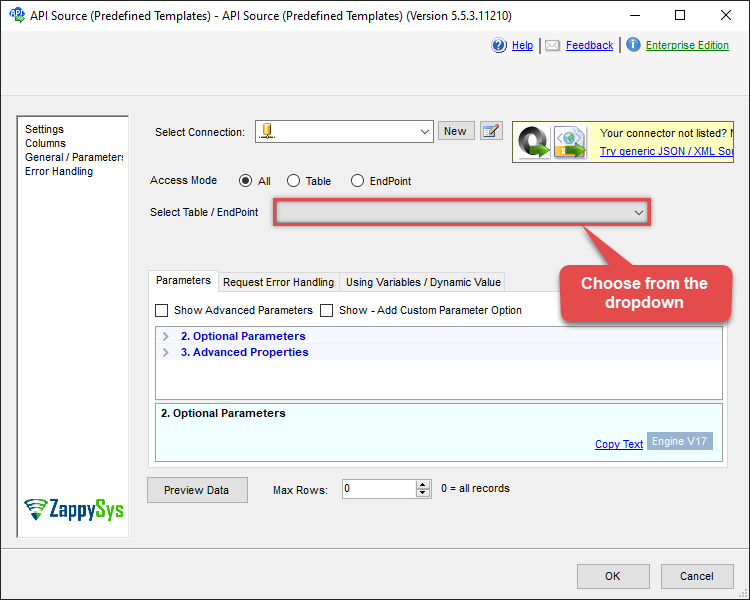
Use Zoho CRM Connector in API Source or in API Destination SSIS Data Flow components to read or write data.
API Source

| Required Parameters | |
|---|---|
| Record ID(s) - Use Comma for multiple (e.g. 111,222) | Fill-in the parameter... |
| Optional Parameters | |
| Fire Wordflow Trigger | |
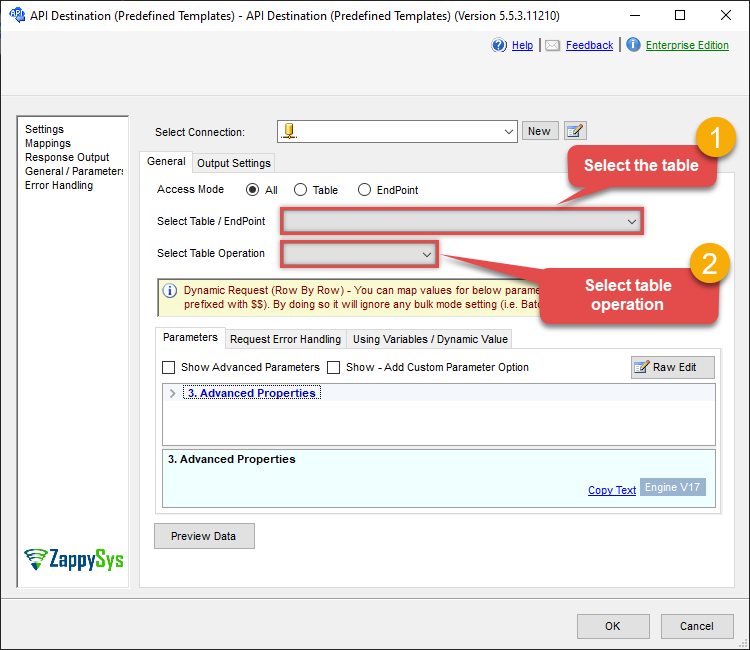
API Destination
This Endpoint belongs to the [Dynamic Table] table, therefore it is better to use it, instead of accessing the endpoint directly. Use this table and table-operation pair to delete [dynamic endpoint]:
| Required Parameters | |
|---|---|
| Record ID(s) - Use Comma for multiple (e.g. 111,222) | Fill-in the parameter... |
| Optional Parameters | |
| Fire Wordflow Trigger | |
ODBC application
Use these SQL queries in your ODBC application data source:
Delete an account
<p>Deletes a single Account record by its ID. This example demonstrates using the <code>DELETE FROM</code> statement with a <code>WHERE</code> clause specifying the record ID.</p>
DELETE FROM Accounts WHERE id=11111111111Delete accounts in bulk
<p>Deletes multiple Account records by specifying a list of IDs. This example demonstrates passing a comma-separated list of IDs to the <code>Id</code> parameter in the <code>WITH</code> clause (up to 100 IDs).</p>
DELETE FROM Accounts WITH(Id='11111,22222,33333')
delete_[dynamic_endpoint_name] endpoint belongs to
[Dynamic Table]
table(s), and can therefore be used via those table(s).
SQL Server
Use these SQL queries in SQL Server after you create a data source in Data Gateway:
Delete an account
<p>Deletes a single Account record by its ID. This example demonstrates using the <code>DELETE FROM</code> statement with a <code>WHERE</code> clause specifying the record ID.</p>
DECLARE @MyQuery NVARCHAR(MAX) = 'DELETE FROM Accounts WHERE id=11111111111';

EXEC (@MyQuery) AT [LS_TO_ZOHO_CRM_IN_GATEWAY];
Delete accounts in bulk
<p>Deletes multiple Account records by specifying a list of IDs. This example demonstrates passing a comma-separated list of IDs to the <code>Id</code> parameter in the <code>WITH</code> clause (up to 100 IDs).</p>
DECLARE @MyQuery NVARCHAR(MAX) = 'DELETE FROM Accounts WITH(Id=''11111,22222,33333'')';

EXEC (@MyQuery) AT [LS_TO_ZOHO_CRM_IN_GATEWAY];
delete_[dynamic_endpoint_name] endpoint belongs to
[Dynamic Table]
table(s), and can therefore be used via those table(s).